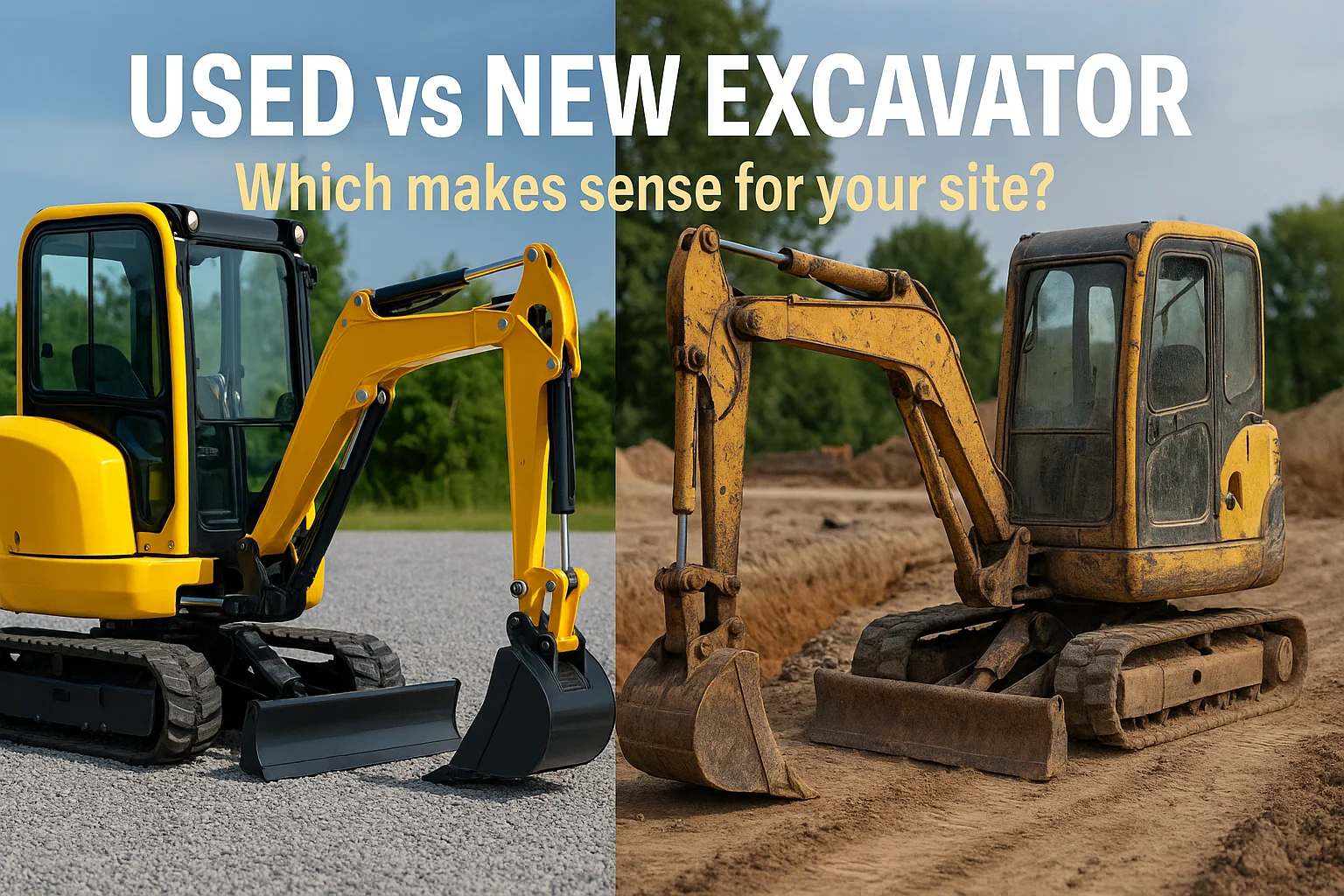
Whether you should buy a used or new excavator depends on three things: how many hours a year you'll run it, whether you're financing, and whether you can properly inspect a used machine. A new mini excavator in South Africa now starts around R265,000, while a nearly-new used one can be found for R225,000 — sometimes the gap is small enough that new wins outright. But on full-size machines, used can cost half the price of new. This guide helps you make the call for your specific farm or site.
The used-vs-new question doesn't have one answer. It changes completely depending on the size of machine and how you'll use it. Let's break it down with real numbers.

Used vs New Excavator: Which Should You Buy?
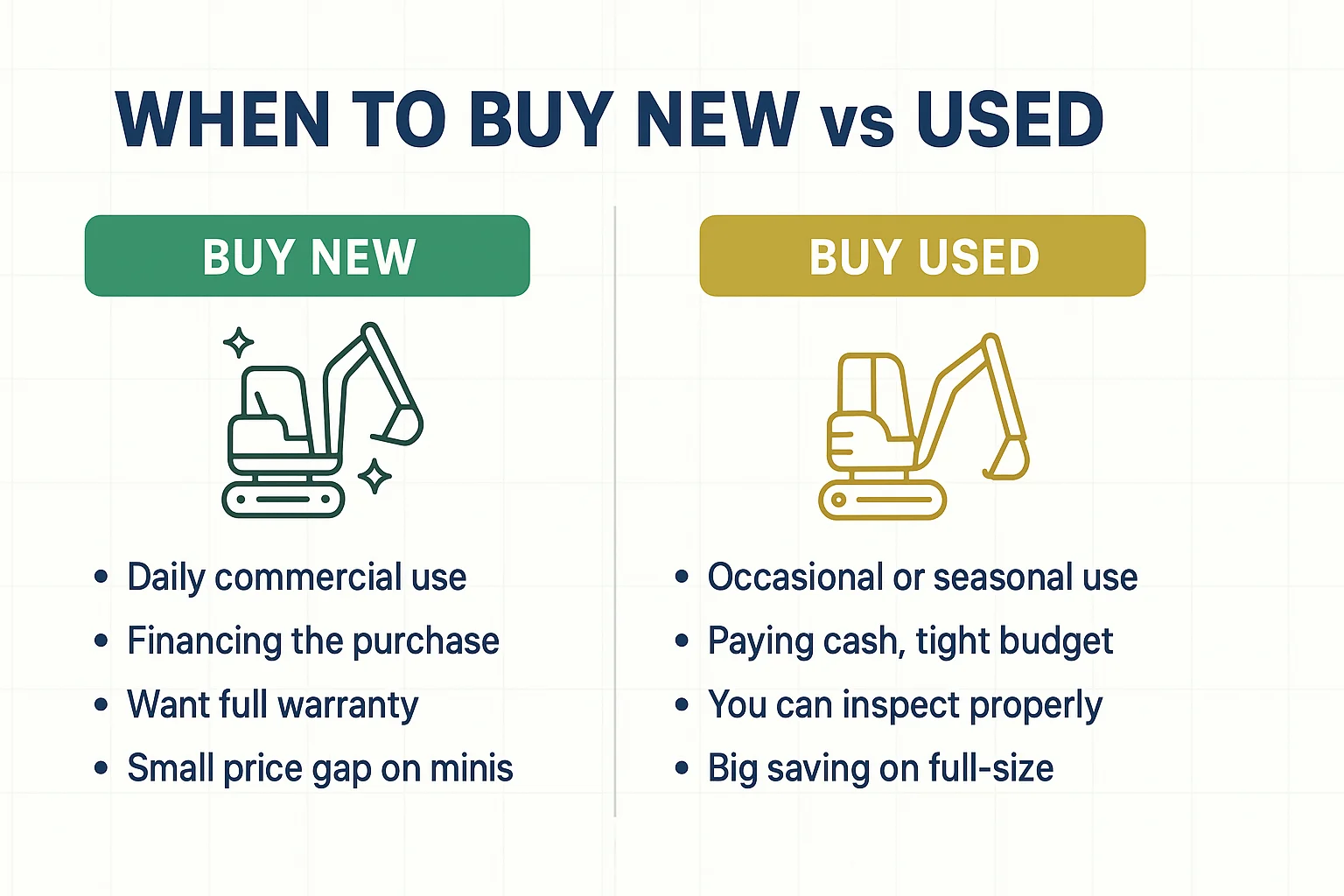
The short answer: buy new if the machine will work daily, you're financing it, or you can't assess a used unit's condition. Buy used if usage is occasional, you're paying cash, and you can inspect properly.
Here's the quick decision summary before we dig into detail:
- High annual hours (commercial, daily): Lean new — warranty and uptime matter most.
- Low annual hours (seasonal farm, occasional site work): Lean used — you'll never wear out the machine anyway.
- Financing the purchase: Lean new — best rates and longest terms.
- Paying cash, tight budget: Lean used — lower entry price, depreciation already absorbed.
- Can't inspect or bring an expert: Lean new — removes the condition gamble.
What's the Price Difference Between Used and New Excavators?
This is where it gets interesting. On mini excavators, value brands have pushed new prices so low that the gap to used is small. Here are current new and used listings on ACM Africa:
| Machine | Condition | Hours | Price |
|---|---|---|---|
| MCM 16DS Mini | New | 0 | R265,000 |
| MCM 16DS Mini | Used (nearly new) | 84 | R225,000 |
| MCM 20DS Mini | New | 0 | R399,000 |
| MCM 20DS Mini | Used | 553 | R325,000 |
| Yuchai U35 Mini (3.5 ton) | New | 0 | R637,000 |
| Yuchai YC60-9 (6 ton) | New | 0 | R739,000 |
Look at the MCM 16DS: R225,000 used at 84 hours versus R265,000 new. That's only R40,000 apart — and for that R40,000, the new machine gives you zero hours, a full warranty, and no question marks. When the gap is that small, new usually wins.
Full-size machines tell a completely different story. Industry estimates suggest a new 20-ton excavator from a premium brand like CAT, Komatsu, Hitachi or Volvo runs R1.8m to R3m or more, while a used example in the 8,000–15,000 hour range can be found between R600,000 and R1.4m depending on brand, hours and condition. On those machines, used can save you well over a million rand.
When Does a New Excavator Make Sense?
A new excavator is the right call in these situations:
- Daily commercial use. If the machine earns money every day, downtime is expensive and a warranty pays for itself.
- You're financing. New machines attract the best interest rates and longest terms because the financier holds clean collateral with a known value.
- Uptime-critical work. Contract deadlines don't wait for a repair. New gives you reliability.
- You want the latest spec. Newer machines are more fuel-efficient and meet current emissions standards.
- You can't assess used condition. If you can't inspect a machine or bring someone who can, new removes the gamble.
- You want full manufacturer warranty. Peace of mind for the first few thousand hours.
Value brands have changed the maths. A new mini excavator from MCM at R265,000, or a Yuchai U35 at R637,000, costs a fraction of what new used to mean. For many buyers, new is now genuinely affordable for the first time — which is why the new-vs-used decision is closer than it's ever been on small machines.
When Does a Used Excavator Make Sense?
A used excavator is the smarter buy when:
- Usage is occasional or seasonal. A smallholder who digs a few trenches a year will never wear out even a high-hour machine.
- You're paying cash. No financing means no benefit from new-machine interest rates.
- Budget is tight. Used gets you working for less upfront.
- You can inspect — or bring an expert. A proper inspection removes most of the risk.
- You want depreciation already absorbed. The first owner took the biggest value hit; you don't.
- The jobs are smaller. Light-duty work doesn't need the newest, most powerful machine.
The sweet spot in the used market is the nearly-new machine — something under 1,000 hours. The MCM 20DS at 553 hours for R325,000 (versus R399,000 new) is a good example: you get most of a new machine's working life while letting someone else absorb the initial depreciation.
What Hidden Costs Do People Forget?
The sticker price isn't the whole picture on either side. Here's the honest accounting.
Hidden costs of buying new
- Depreciation. Industry estimates suggest an excavator loses 20–30% of its value in the first year alone. That's the single biggest cost of buying new, and you don't see it until you sell.
- Financing interest. Over a 36–60 month term, interest adds meaningfully to the total cost.
Hidden costs of buying used
- Potential repairs. You may inherit wear that needs attention soon.
- No warranty. Any failure is your bill.
- Unknown history. Without service records, you're guessing at how the machine was treated.
- Immediate service costs. Budget for a full service and fluid change on day one.
Net it out honestly: a new machine's depreciation often roughly matches a used machine's repair-and-service risk over the first few years. The deciding factor is usually how much you value certainty versus a lower upfront price.
Does the New-or-Used Maths Change by Machine Size?
Yes — dramatically. This is the single most important point in the whole decision.
On mini excavators (under 6 tons), value-brand new pricing is so low that new often wins. When a new MCM 16DS is R265,000 and a used one is R225,000, the R40,000 saving rarely justifies taking on a used machine's unknowns.
On full-size excavators (20–30 tons), the new premium is enormous. A new 20-ton machine at R1.8m–R3m versus a well-inspected used one at R600k–R1.4m is a saving of a million rand or more. At that scale, used machines dominate the market for good reason — almost nobody buys a brand-new 20-tonner unless a fleet operator needs warranty-backed uptime.
"On small machines, ask whether new is worth the small premium. On big machines, ask whether you can find a used one in good enough condition. The questions are completely different," is how we'd frame it for buyers weighing the two.
How Many Hours Is Acceptable on a Used Excavator?
Hours are the biggest driver of used excavator value. As a quick guide:
- Compact / mini (under 10 ton): Under 5,000 hours is ideal. Under 1,000 is nearly-new territory.
- Full-size (20–30 ton): 4,000–8,000 hours is the sweet spot. 8,000–15,000 is high but workable with good history. 15,000+ usually means a major rebuild is due.
But hours alone never tell the whole story — a well-serviced 6,000-hour machine can beat a thrashed 2,000-hour one. We cover this in depth in how many hours is too many on used equipment, which breaks down acceptable hours for every machine category.
New vs Used Excavator: The Decision Checklist
Use this to make the call:
Buy new if:
- The machine will work daily or near-daily
- You're financing the purchase
- You want a warranty and zero unknowns
- It's a mini and the new-vs-used gap is small
Buy used if:
- Usage is occasional or seasonal
- You're paying cash on a tight budget
- You can inspect or bring an expert
- It's a full-size machine where used saves a fortune
Whichever way you lean, if you go used, always inspect. Our 8-point inspection guide was written for TLBs but applies just as well to excavators. Two excavator-specific checks to add: inspect the undercarriage (tracks, rollers, idlers and sprockets wear linearly with hours and are expensive to replace), and verify hydraulic hours against engine hours — a big gap means the machine spent a lot of time idling.
Where Can You Compare Used and New Excavators?
ACM Africa lists both new and used excavators from verified dealers — including MCM and Yuchai — alongside private sellers, all with direct WhatsApp contact. You can browse all excavator listings and filter by price, hours, condition and province to compare new against used side by side.
Because every listing shows the price, hours and condition up front, you can benchmark a used machine against the new equivalent in minutes — exactly the comparison this guide is built around. Browse verified equipment dealers or see how excavator pricing compares to our TLB price guide for the bigger picture on equipment costs.
The Bottom Line
There's no universal answer to used versus new. The right choice depends on your hours per year, your finance situation, and whether you can properly inspect a used machine.
Value brands have made new mini excavators genuinely affordable, narrowing the gap to the point where new often makes sense on small machines. On full-size excavators, the new premium is large enough that well-inspected used machines still dominate. Match the machine to the work, run the numbers honestly on both sides, and always inspect any used unit before you pay.
Ready to buy an excavator?
Browse new and used excavators for sale in South Africa on ACM Africa — mini, medium and large machines from verified dealers and private sellers. Contact directly on WhatsApp, no middleman.
Browse excavators for sale →