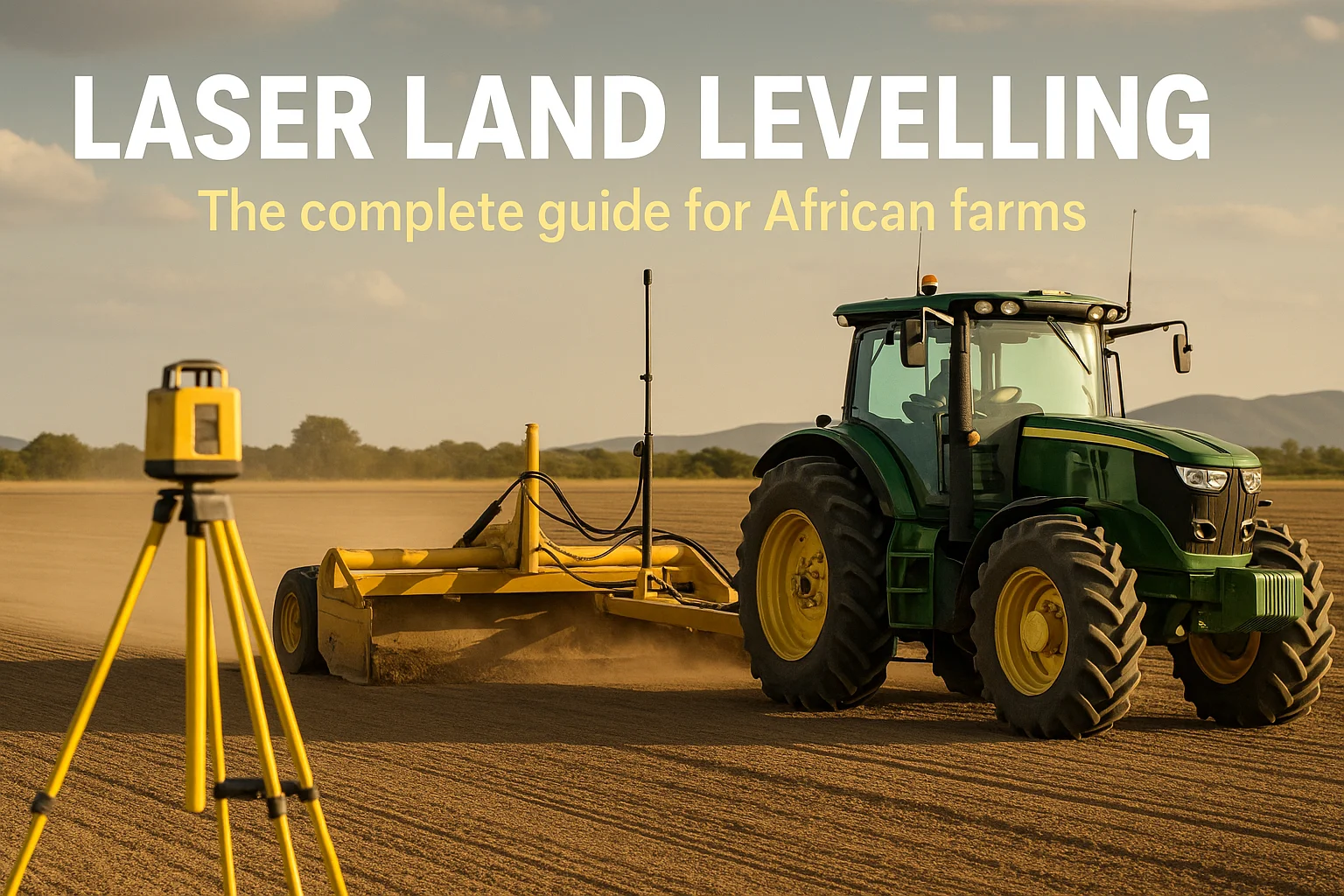
Laser land levelling uses a rotating laser plane and an automatic receiver to grade a field with precision — cutting high spots, filling low spots, and creating a surface that's either dead flat or set to a designed slope. For irrigated farms, it's one of the highest-return precision-farming investments you can make, cutting water use and lifting yields. Systems on ACM Africa range from entry GPS land meters around R7,500 to full laser levelling scrapers around R512,000. This guide explains how the technology works, the different system types, what it costs, and how to choose the right one.
If you flood- or furrow-irrigate, level your land properly and you'll waste less water, get more even crops, and make every drop count. Here's everything you need to know.

What Is Laser Land Levelling and How Does It Work?
Laser land levelling is a system that automatically grades a field to a precise level or slope using a laser beam as the reference. Instead of an operator guessing where the high and low spots are, the laser does the measuring and the hydraulics do the cutting and filling — automatically.
A complete system has four main parts:
- Laser transmitter. Mounted on a tripod at the edge of the field, it spins and projects a flat (or sloped) plane of laser light across the whole working area.
- Receiver. Mounted on a mast on the tractor, scraper or levelling bucket, it reads where the laser plane is and tells the system whether the blade is too high or too low.
- Control box. Sits in the cab. It takes the receiver's signal and decides what the hydraulics need to do.
- Hydraulic valve and scraper/bucket. The valve automatically raises or lowers the levelling bucket so the cutting edge follows the laser plane exactly, cutting high ground and filling hollows.
The result is a field graded to within a couple of centimetres of the target plane across its entire surface — far more accurate than any operator could achieve by eye. The machine does the precision; the operator just drives.
Why Does Land Levelling Matter for African Farms?
A level field is the foundation of efficient irrigation. When the surface is uneven, water pools in the low spots and never reaches the high ones — so part of the field drowns while another part stays thirsty. Levelling fixes that.
The main benefits for African farms:
- Even water distribution. In flood and furrow irrigation, a level field waters uniformly instead of pooling.
- Major water savings. Industry estimates suggest precise levelling can reduce irrigation water use significantly compared with an uneven field — a huge deal where water is scarce and expensive.
- Better germination and crop uniformity. Even moisture means even emergence and a more consistent crop.
- Less fertiliser runoff. Water that doesn't pool and run off keeps nutrients in the root zone.
- Less waterlogging. No more drowned patches in the hollows.
- Easier mechanisation. A flat field is faster and safer to plant, spray and harvest.
- Higher yields. Industry estimates link good levelling to meaningful yield improvements on irrigated land.
"On flood-irrigated land, levelling is often the single highest-return improvement a farmer can make — the water savings alone can justify it in a season or two," is a view widely shared among irrigation specialists.
Single-Plane vs Dual-Plane vs 3D/GPS Levelling: What's the Difference?
Laser levelling systems come in three broad types, increasing in capability and price. Choosing the right one depends on how complex your fields and grades are.
| System type | What it does | Best for |
|---|---|---|
| Single-plane | Levels to one flat plane or a single constant slope | Basins, simple flat fields, straightforward grading |
| Dual-plane (2-axis) | Controls slope in two directions (X and Y) for proper fall both ways across the field | Irrigation and drainage that needs fall in two directions |
| Three-plane / 3D / GPS-GNSS | Shapes complex surfaces and designed grades using satellite positioning | Large-scale earthworks, complex designed grades, precision contouring |
Which system type do you actually need?
Most flood and furrow irrigators do well with a single-plane or dual-plane system. Single-plane suits simple basin layouts; dual-plane is the workhorse for fields that need controlled fall in two directions for proper irrigation and drainage. Three-plane and GPS-GNSS systems are the tool of choice for contractors and large operations shaping complex or designed surfaces over big areas.
What Does a Laser Levelling System Cost in South Africa?
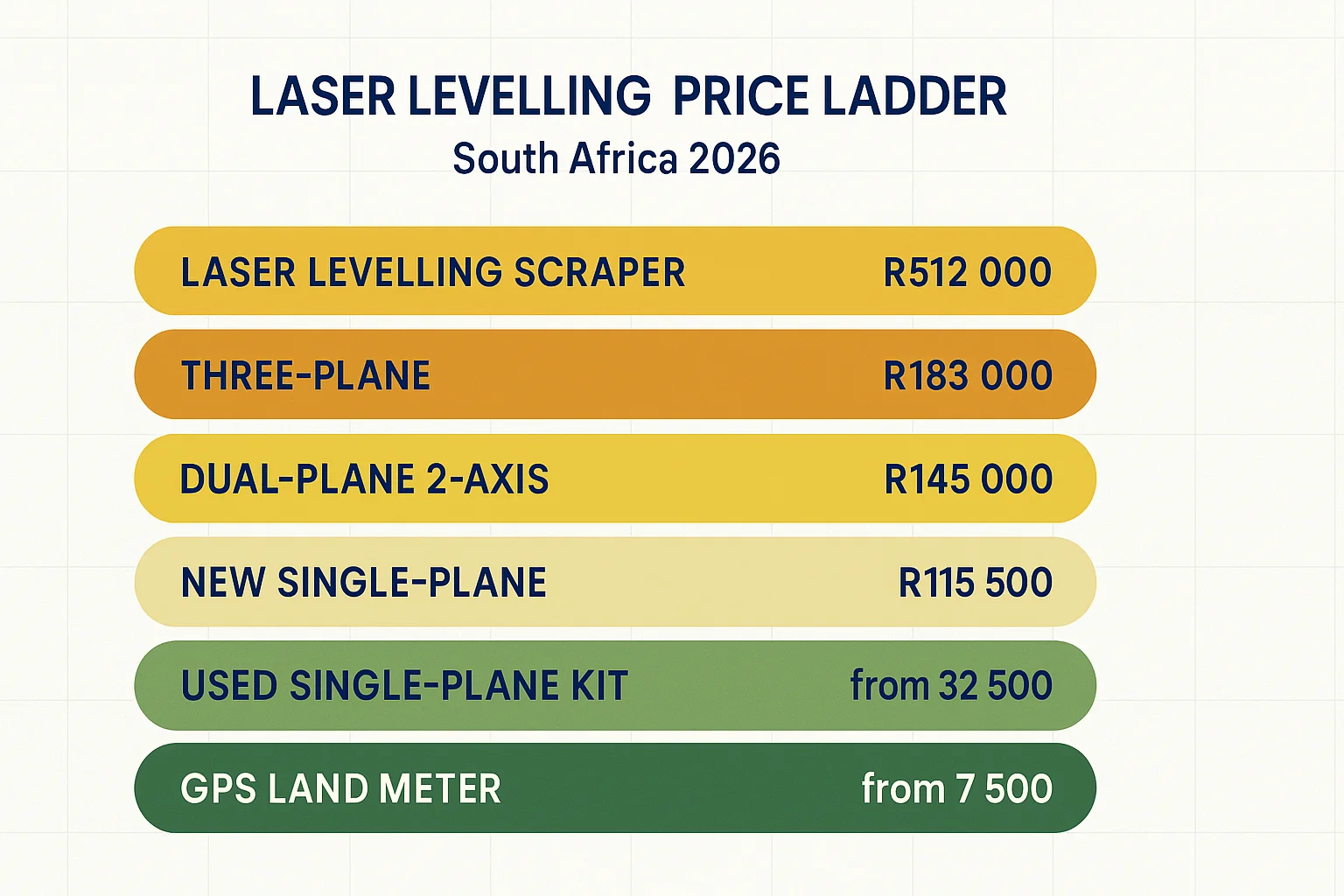
Laser levelling spans a wide price range — from an affordable measuring tool to a full automated implement. Here are current price tiers based on ACM Africa listings:
| System | Condition | Approx. price |
|---|---|---|
| GPS/GNSS land meter for tractors (measuring tool) | New | From ~R7,500 |
| Single-plane laser level kit (transmitter + receiver) | Used | From ~R32,500 |
| Single-plane laser levelling system | New | ~R115,500 |
| Dual-plane (2-axis) laser levelling system | New | ~R145,000 |
| Three-plane laser levelling system | New | ~R183,000 |
| Laser levelling scraper (full implement) | New | ~R512,000 |
A used single-plane kit from around R32,500 is the most affordable entry point for a farmer who wants to try laser levelling without a major outlay. At the other end, a complete laser levelling scraper is a full implement that includes the earth-moving hardware, not just the laser kit — which is why it sits near R512,000.
Is Laser Levelling Worth It for a Small or Medium Farm?
It depends on three things: your field size, your irrigation method, and the cost of your water.
For flood and furrow irrigators, laser levelling often pays back fast. The water savings alone — on a scarce, expensive input — can recover the cost within a season or two, on top of the yield gains. If you irrigate this way, it's one of the easiest precision investments to justify.
For small dryland plots that rely on rainfall, the case is weaker — you don't get the irrigation water savings that drive most of the return. And for very small areas, the cost per hectare of owning a system is high.
If you don't want to buy a system outright, there's a middle path: some contractors offer land levelling as a service, charging per hectare. That lets you get a field professionally levelled without owning the equipment — sensible if you only need it occasionally or want to test the benefit before investing.
What Should You Look for When Buying a Laser Levelling System?
Whether new or used, run through this checklist before you buy:
- New vs used. Used kits are far cheaper but need careful checking (see calibration below).
- Transmitter range. Make sure it covers the size of field you work — bigger fields need longer range.
- Single, dual or three-plane. Match it to your grading needs; don't overpay for capability you won't use.
- Receiver and control box condition. On used systems, these are the components that matter most.
- Battery and charger included. Confirm what's in the kit — replacement batteries and chargers cost money.
- Calibration status. Critical — covered below.
- African-conditions durability. Heat and dust are hard on electronics. Ask how the system handles them.
- Parts and support availability. Make sure you can get help and spares if something fails.
- What's included. Some listings are the laser kit only; others include the scraper or levelling bucket. Know exactly what you're buying.
Why Does Calibration Matter So Much?
A laser level that has drifted out of calibration will create an inaccurate grade — which is worse than not levelling at all. If the laser plane is off, the system will confidently cut and fill to the wrong heights, leaving you with a field that looks levelled but drains badly.
Temperature drift is a real issue in African conditions. A system that reads accurately in the cool of the morning can drift as the day heats up, so by midday it's levelling to a slightly different plane. Quality systems are built to minimise this, but it's something to ask about — especially on imported units not set up for local heat.
Always verify calibration before relying on a system, and have any used laser professionally calibration-checked before you put it to work in the field. It's a small cost that protects a whole season's grading.
Can You Buy Used Laser Levelling Equipment?
Yes — and it's a smart way to get started affordably. Used single-plane kits start at around R32,500 on ACM Africa, a fraction of new-system prices.
When buying used, check these specifically:
- Calibration. The single most important check — have it verified.
- Receiver accuracy. Confirm it reads the laser plane correctly and consistently.
- Control box function. Make sure it drives the hydraulics properly.
- Cables and connectors. Worn or corroded connectors cause intermittent faults.
- Battery health. Old batteries lose capacity and may need replacing.
The same buying discipline that applies to any used machine applies here — inspect properly and verify function before you pay. Our guide to inspecting used equipment covers the general principles, and the calibration check above is the laser-specific addition.
Where Can You Find Laser Land Levelling Equipment in Africa?
ACM Africa lists laser and GPS land levelling systems under Surveying Equipment — from entry-level GPS land meters to full laser levelling scrapers, new and used. You can browse agriculture equipment or the full machines catalogue and contact sellers directly via WhatsApp to discuss specs, calibration and what's included.
Because listings span the whole range — from a R7,500 GPS land meter to a R512,000 laser scraper — you can match the system to your field, your irrigation method and your budget, and compare new against used in one place. Browse verified sellers across the continent to see what's available.
The Bottom Line on Laser Land Levelling
Laser levelling is one of the highest-return precision-farming investments for irrigated land in Africa, where water is scarce and every drop matters. A precisely graded field uses less water, grows a more even crop, and is easier to work.
Match the system type to your field and irrigation method — single-plane for simple layouts, dual-plane for two-way fall, three-plane or GPS for complex grades. Always verify calibration, especially on used systems. And weigh up buying versus hiring a contractor if your acreage is small. Get it right, and a level field will pay you back season after season.