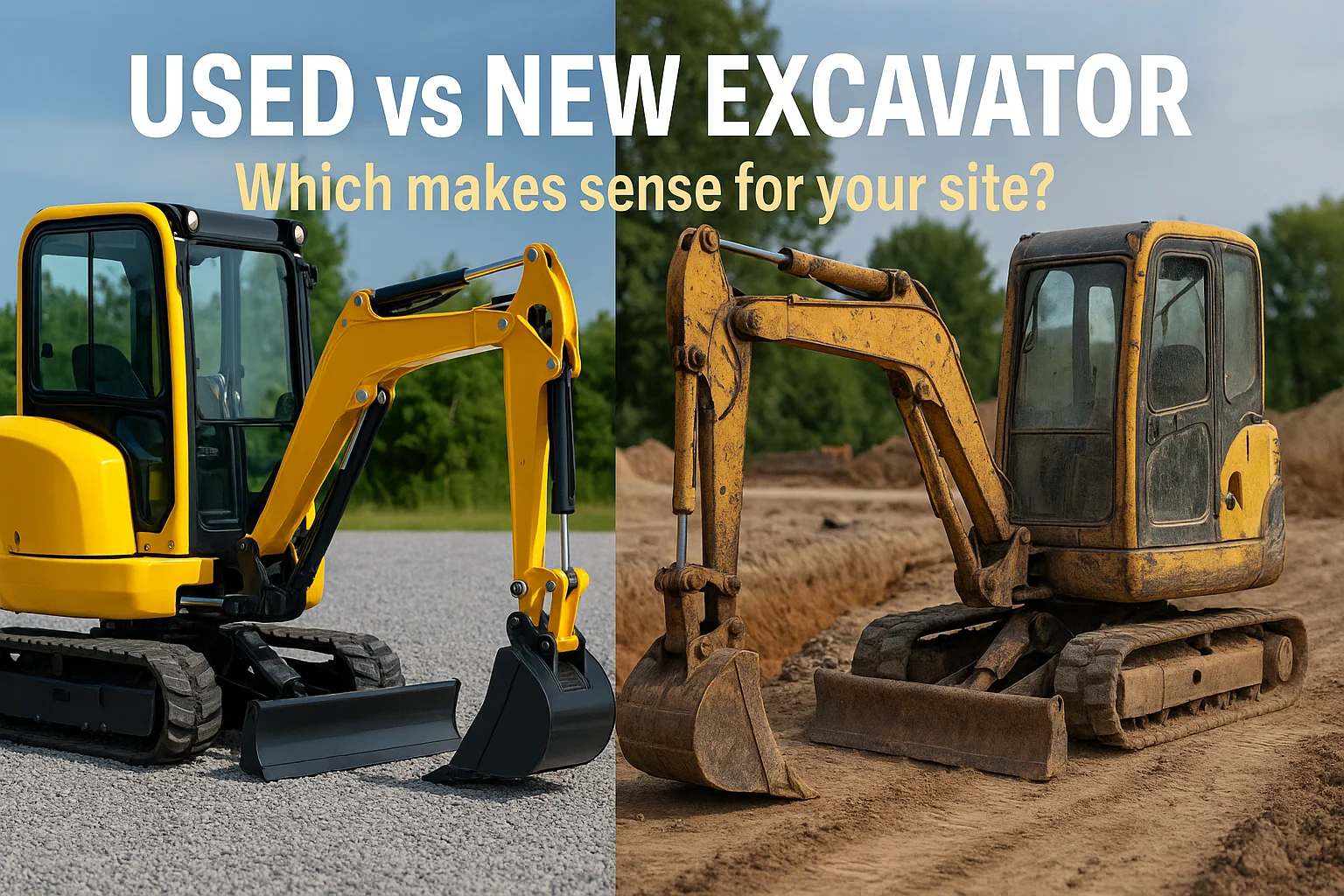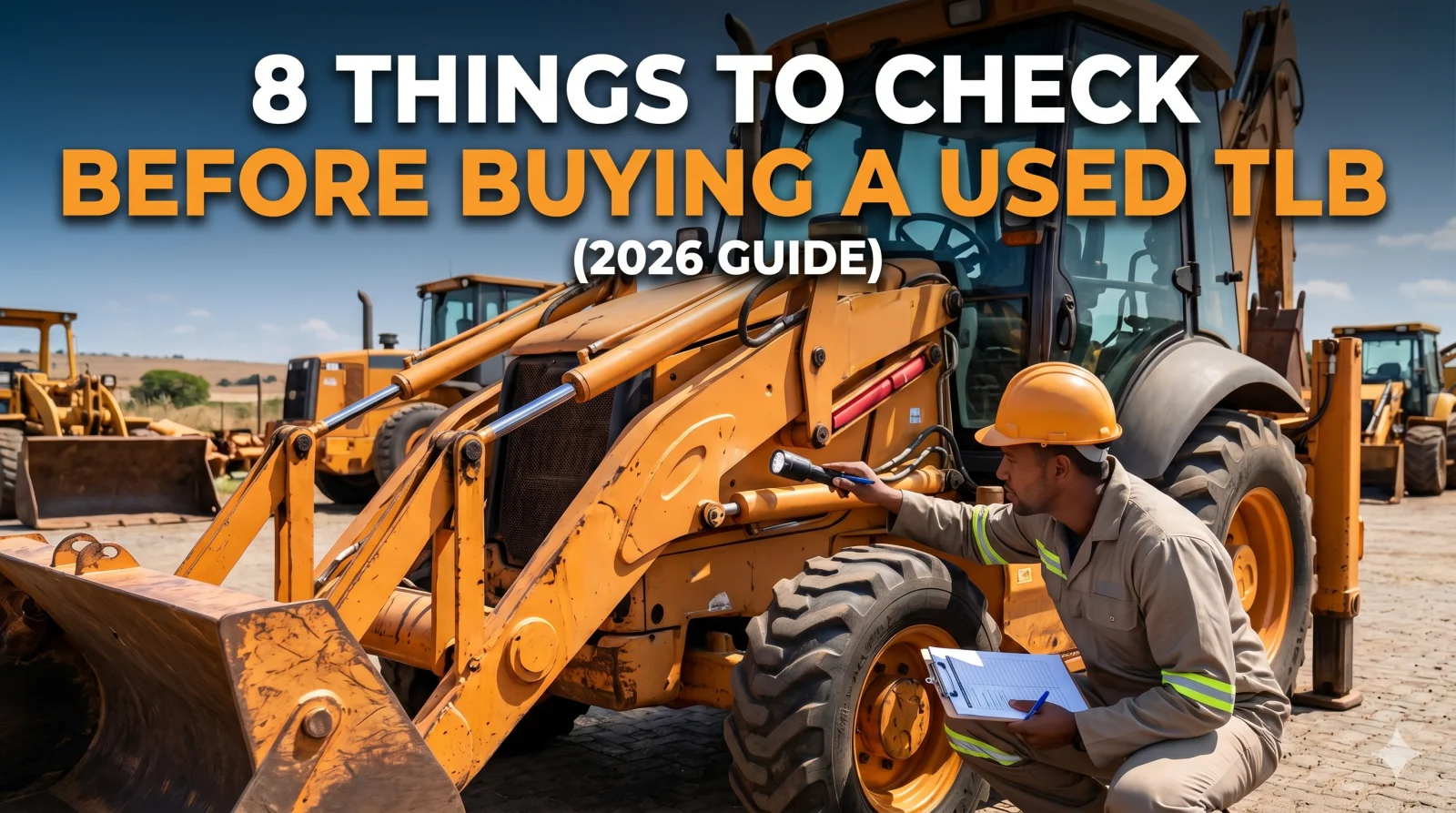
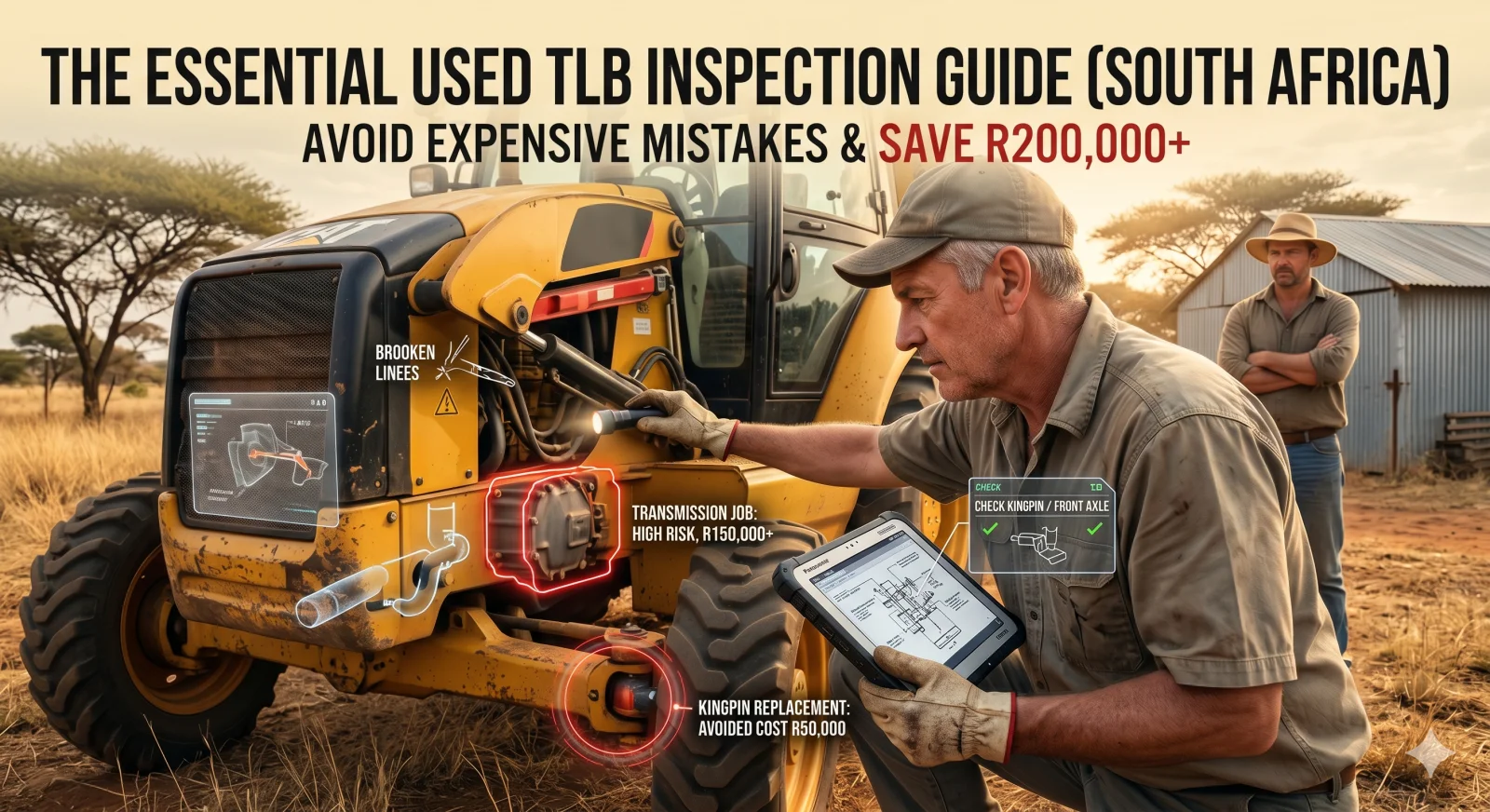
A used TLB can save you R200,000 or more versus a new machine — but only if you buy a good one. The wrong unit becomes a permanent expense: hydraulic rebuilds, transmission jobs, kingpin replacements and downtime that quietly eat the saving in eighteen months. This guide is what to actually inspect, in order, before you transfer money for a used backhoe loader in South Africa.
It's written for the person who is about to drive out to view a machine — farmer, contractor, fleet manager, or first-time TLB buyer. Nothing here is theoretical. Every check is something experienced buyers do because they have, at some point, been burned.
Before You Start
Bring these with you when you go to inspect a TLB:
- A torch (the dirty corners are where problems hide)
- A clean rag (for checking oils)
- Work gloves
- A magnet (to verify there's no body filler over rust)
- A friend or assistant to operate controls while you watch
- Two hours of uninterrupted time
- Cash for fuel if the seller hasn't pre-fuelled the machine for the test
Plan for the inspection to start with the machine cold. Tell the seller in advance not to warm it up. A cold engine reveals problems that a warm one hides.
1. How Do You Know the Real Hour-Meter Hours?
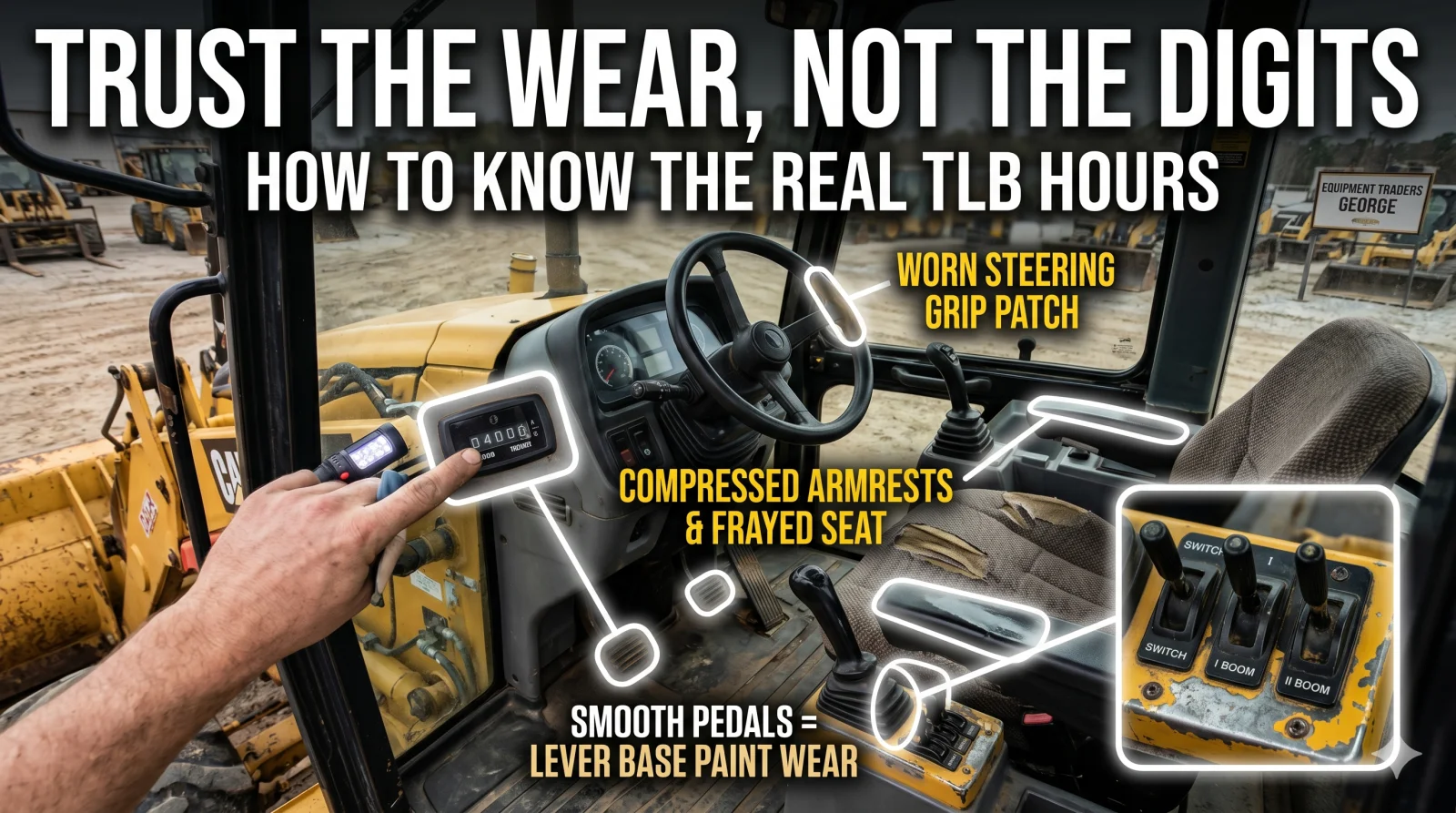
The hour meter is the first thing every buyer looks at — and the first thing dishonest sellers tamper with. Trust the wear, not the digits.
Industry estimates suggest a well-maintained TLB has a useful life of 10,000–15,000 hours before major rebuilds. A machine claiming 4,000 hours but showing 12,000 hours of wear has been wound back. Here's how to spot it:
- Pedal rubbers and floor mat: A 4,000-hour machine should still have legible tread on the pedals. Smooth, rounded pedal faces mean closer to 10,000 hours.
- Seat fabric and armrests: Compressed, sagging, polished armrests mean serious hours.
- Steering wheel wear: Worn patches at 10 and 2 o'clock positions, polished grip — high hours.
- Paint wear around lever bases: Bare metal around the loader and backhoe control levers tells the truth the meter often won't.
- Boot prints on the step: Deep wear in the step plates is a leading indicator on machines over 8,000 hours.
If the wear doesn't match the digits, walk away or renegotiate hard. A wound-back meter is fraud, not a discount opportunity.
2. What Should the Hydraulic System Tell You?
The hydraulics are the most expensive system on a TLB. A full pump-and-cylinder rebuild on a mid-size machine starts around R45,000 and can climb past R120,000. Three checks tell you 90% of what you need to know:
Check the oil
Pull the hydraulic dipstick (or open the tank inspection cap). Clean ATF-coloured fluid is good. Milky or cloudy oil means water contamination. Dark brown or burnt-smelling oil means the pump has been running hot. Black, with metallic sparkle, means metal is shedding inside — walk away.
Walk every ram
Inspect each cylinder — boom, dipper, bucket, swing, stabilisers, loader lift and tilt. Look for wet oil running down the rod, or oily dirt build-up at the rod seal. A small weep is acceptable on an older machine. Active dripping is not.
Drift test
Lift the backhoe bucket loaded with soil to mid-height and stop. Walk away for 5 minutes. Come back and check whether the bucket has dropped. Up to about 20mm of drift in 5 minutes is normal for a used machine. More than that means worn cylinder seals or a tired control valve — expect a hydraulic bill in your future.
Finally, lift the loader bucket to full height while listening at the pump. A high-pitched whine or rattling at full lift can be cavitation, often caused by a blocked suction filter or a failing pump. It's worth asking when the suction filter was last replaced.
3. How Do You Check the Engine on a Used TLB?
The engine is the second most expensive component. The good news is that diesel engines on TLBs are simple, and most problems are visible if you know where to look.
Insist on a cold start. A healthy diesel should fire on the first or second crank with light grey or no visible exhaust. Sustained white smoke (more than 5 seconds) suggests poor compression, water in the cylinder, or worn injectors. Persistent blue smoke means oil is being burnt — rings or valve seals are gone. Black smoke under load is acceptable on older engines; black smoke at idle is not.
While the engine is running:
- Pull the oil filler cap. Light puffs of air are normal. Strong steady blow-by, with visible smoke coming out of the filler hole, means the rings are worn and a top-end rebuild is on the horizon.
- Check engine oil colour. Recently changed oil is honey-coloured. Black is fine if service is current. Milky or coffee-coloured oil means coolant has entered — head gasket failure.
- Check the coolant. Open the radiator cap (only when cool). Coolant should be the original colour — green, red or blue depending on type. Oily sheen on top means head gasket or oil cooler problems.
- Watch the exhaust under load. Get the seller to lift a full bucket while you watch the stack. Heavy black smoke = injector or turbo issue.
4. Why Do Pins, Bushings and the Kingpin Matter So Much?
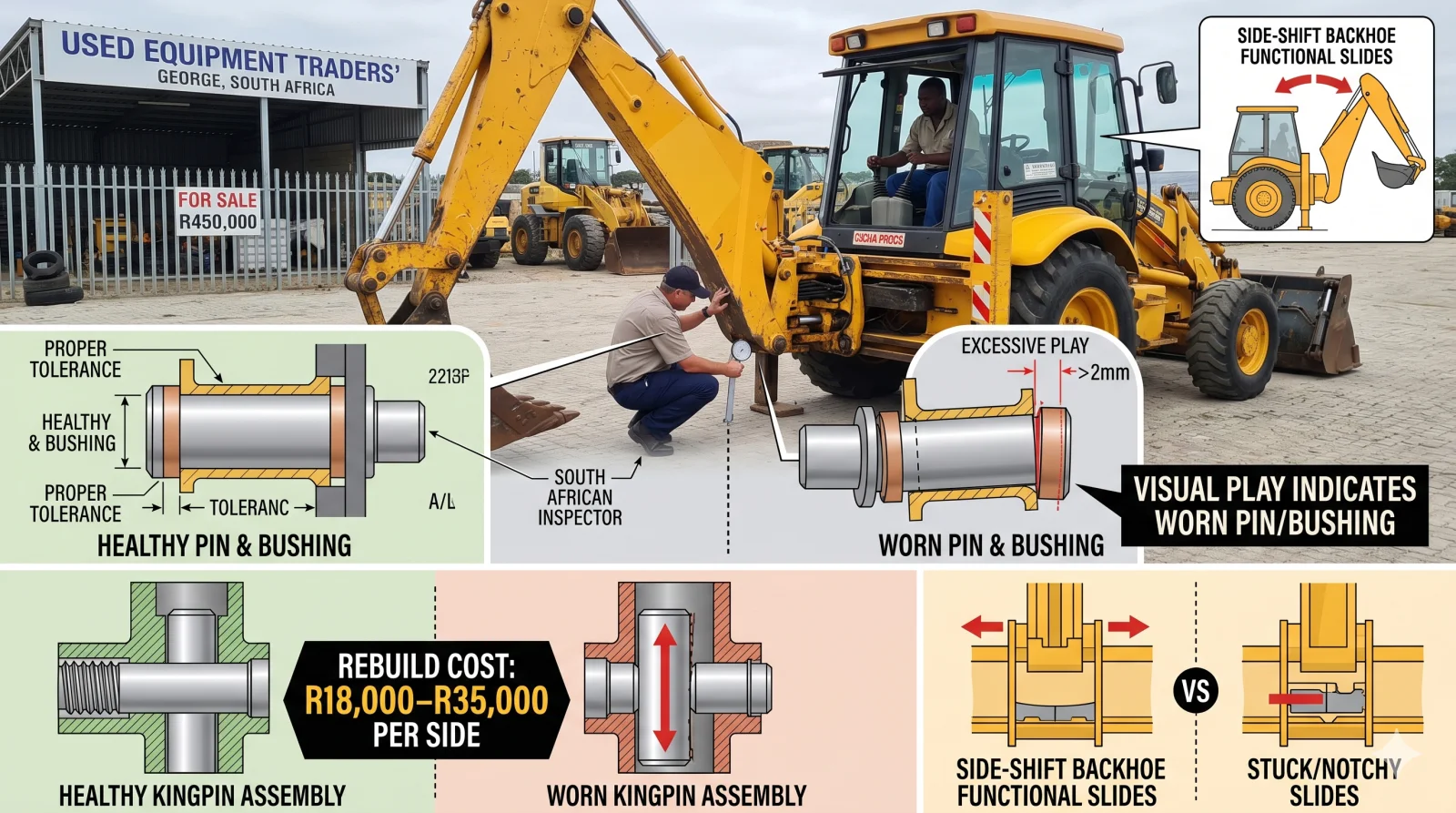
Worn pins and bushings are the cheapest fix on this list to verify and one of the most expensive to ignore. A full kingpin rebuild on a TLB averages R18,000–R35,000 per side, depending on brand.
With an assistant in the cab:
- Have them slowly work each lever — boom, dipper, bucket, swing — while you watch the pin joints from outside.
- Visible movement between pin and bushing of more than 1–2mm means worn pins. Look at the lower boom pivot and the dipper-to-bucket linkage especially.
- Check the kingpin (front axle pivot). Have them turn the wheel lock-to-lock while you watch the kingpin housing. Up-and-down play means worn kingpin bearings. This is a frequent fault, especially on machines that have been worked with the loader heavily loaded.
- On machines with side-shift backhoes, work the side-shift fully each way. Notchy or stuck movement means the slides need cleaning or replacing.
5. How Do You Test the Transmission and Drive Properly?
The transmission and shuttle shift get hammered on a TLB. Most operators slam between forward and reverse hundreds of times a day, and the torque converter takes the heat.
With the machine in a flat open area:
- Stall test the torque converter. With the machine held against a low gear and the brakes on, gently apply throttle. The engine should bog down slightly and hold. If the engine stalls completely, the converter is locked. If the engine revs freely without any resistance, the converter is slipping badly.
- Test the shuttle shift. Drive forward, stop, shift to reverse and accelerate. The change should be smooth but firm. Harsh banging or slow engagement means the shuttle clutches are worn.
- Listen in 1st and 2nd gear at low speed. A constant whining noise that changes with road speed (not engine speed) suggests differential or final drive wear.
- Engage 4WD on hard ground. Lifting and dropping the front axle slightly should engage the front drive without binding. Test in low-speed turns to confirm.
6. What Do the Tyres and Axles Reveal?
Tyres are not just about tread — they're a diagnostic surface.
- Uneven front wear (more wear on inner or outer edge) usually means worn kingpins, sloppy track-rod ends, or simply that the machine was operated badly with the loader full. Either way, factor in alignment or kingpin work.
- Mismatched rear tyres — different brands, sizes or tread patterns — can damage the limited-slip differential if used long-term. Ask why they're mismatched.
- Axle hub oil leaks. Run your hand around the back of each wheel hub. Oily build-up means the axle seals are leaking. Left untreated, this destroys the bearings inside.
- Check the rear axle breather. If it's blocked, axle pressure builds up and pushes oil out of the seals.
A new set of rear TLB tyres in South Africa runs R28,000–R45,000 fitted. Factor that into your offer if the rears are below 30%.
7. Which Documents Must Match Before You Pay?
South Africa's used machinery market includes its share of stolen, finance-encumbered, and grey-import machines. Verify paperwork before any deposit changes hands.
- Chassis number on the machine matches the papers. Find the stamped chassis plate (usually on the right-hand side of the boom castle or chassis rail). Photograph it. Match it to the invoice or NaTIS document.
- Service history, if claimed. Ask to see the books or invoices. If the seller says "we've serviced it ourselves," ask which oil grade and what service intervals — vague answers tell you what you need to know.
- Outstanding finance check. In South Africa, request a verification from the seller's finance house if there's a settlement letter. Buying a machine with outstanding finance means the financier can repossess it from you.
- For Chinese-brand TLBs (MCM, HZM, LGMA, Everun and others), confirm the original importer. The official local dealer can verify warranty status, parts availability and serial-number authenticity. ACM Africa's dealer directory lists verified importers and dealers across Southern Africa.
"Verifying chassis numbers against papers is the single most-skipped step in private TLB sales, and it's the one that costs buyers the most when it goes wrong," notes the ACM Africa team based on recurring buyer queries to the platform.
8. Why Must You Test the Machine Doing Real Work?
Most TLBs run fine at idle. Problems only show up when the hydraulics are loaded, the transmission is under torque, and the engine is being asked to perform.
Before you commit, insist on a working test:
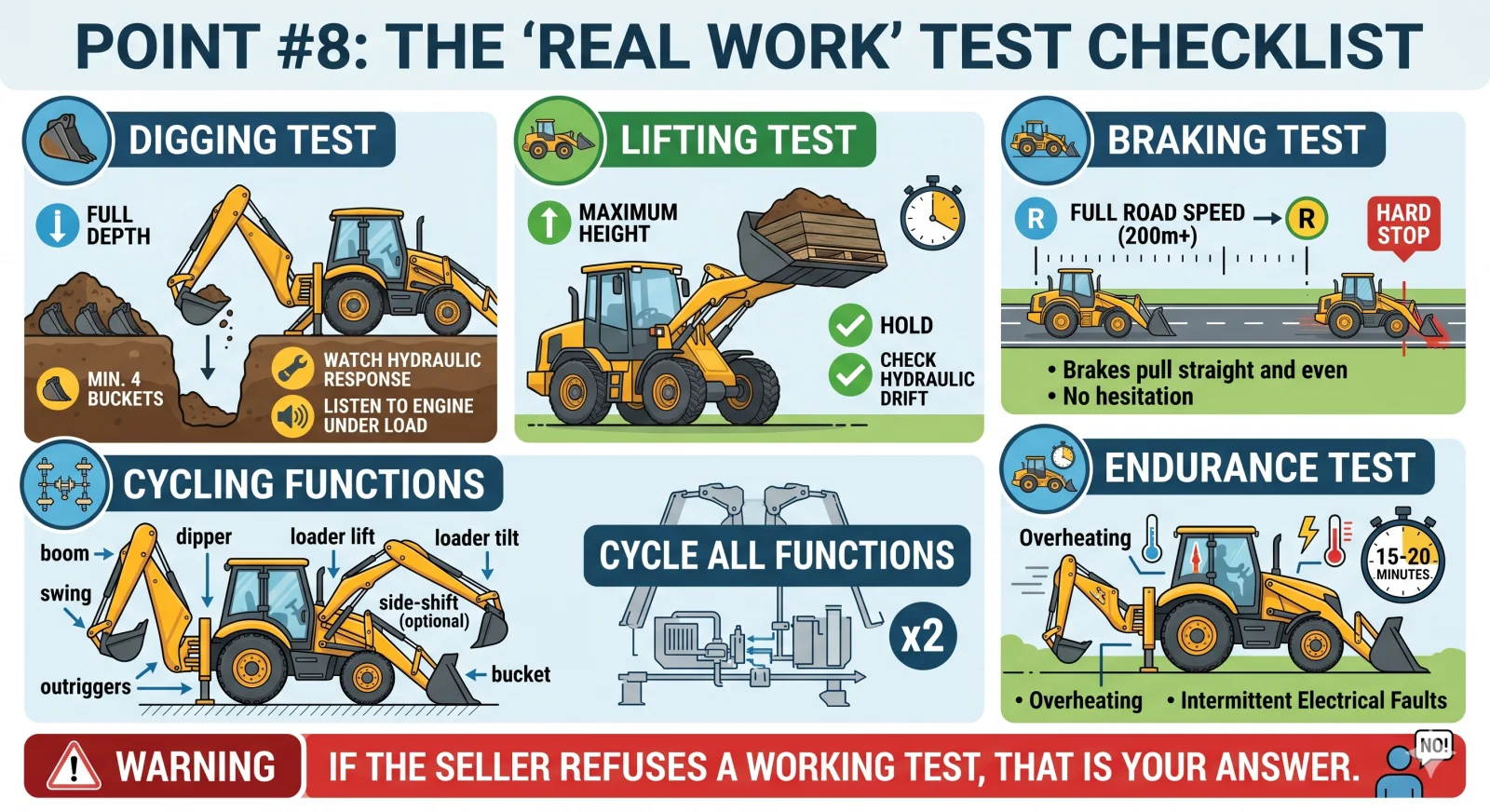
- Dig a trench — full-depth, four buckets minimum. Watch the hydraulic response and listen to the engine.
- Lift a known load — a full bucket of soil, or a pallet — to maximum height and hold.
- Drive at full road speed across at least 200m, then stop hard. The brakes should pull straight and even.
- Cycle every single hydraulic function — outriggers, swing, boom, dipper, bucket, side-shift if fitted, loader lift, loader tilt — twice each.
- Run the machine for 15–20 minutes minimum. Some problems (overheating, intermittent electrical faults) only show up after time.
If the seller refuses a working test, that is your answer. A confident seller of a sound machine has no reason to refuse.
What Should You Pay for a Used TLB in 2026?
Pricing varies enormously by brand, hours and condition, but here's a broad guide based on ACM Africa platform data and current new-machine pricing:
| Category | New (typical range) | Used, 3–5 years, <5,000 hrs |
|---|---|---|
| Compact TLB (25–35 kW) | R329,500 – R450,000 | R220,000 – R310,000 |
| Mid-size TLB (45–60 kW) | R550,000 – R750,000 | R380,000 – R520,000 |
| Full-size TLB (60+ kW) | R750,000 – R950,000 | R500,000 – R680,000 |
Average price gap between new and 3–5 year-old machines: roughly 30–45%. For higher-hour units (8,000+ hours), expect a further 25–35% discount on the figures above.
Final Word: When in Doubt, Walk Away
The South African used TLB market is large. There is always another machine. The cost of walking away from a doubtful unit is zero. The cost of buying one is whatever the next 18 months of repairs add up to.
If a deal feels rushed, if the seller resists checks, if the paperwork is "coming on Monday," or if the price feels too low — those are warning signs, not bargaining levers.
When you're ready to look at real listings, browse active used TLBs on ACM Africa. Verified dealers like MCM (currently with 22 active TLB listings), HZM and LGMA publish their full inventory with photos, hours and pricing on the platform — and you can contact them directly via WhatsApp from any listing.
Looking for a used TLB?
Browse used and new TLBs for sale in South Africa on ACM Africa. Filter by brand, hours and price, then contact the seller directly on WhatsApp.
Browse TLBs for sale →