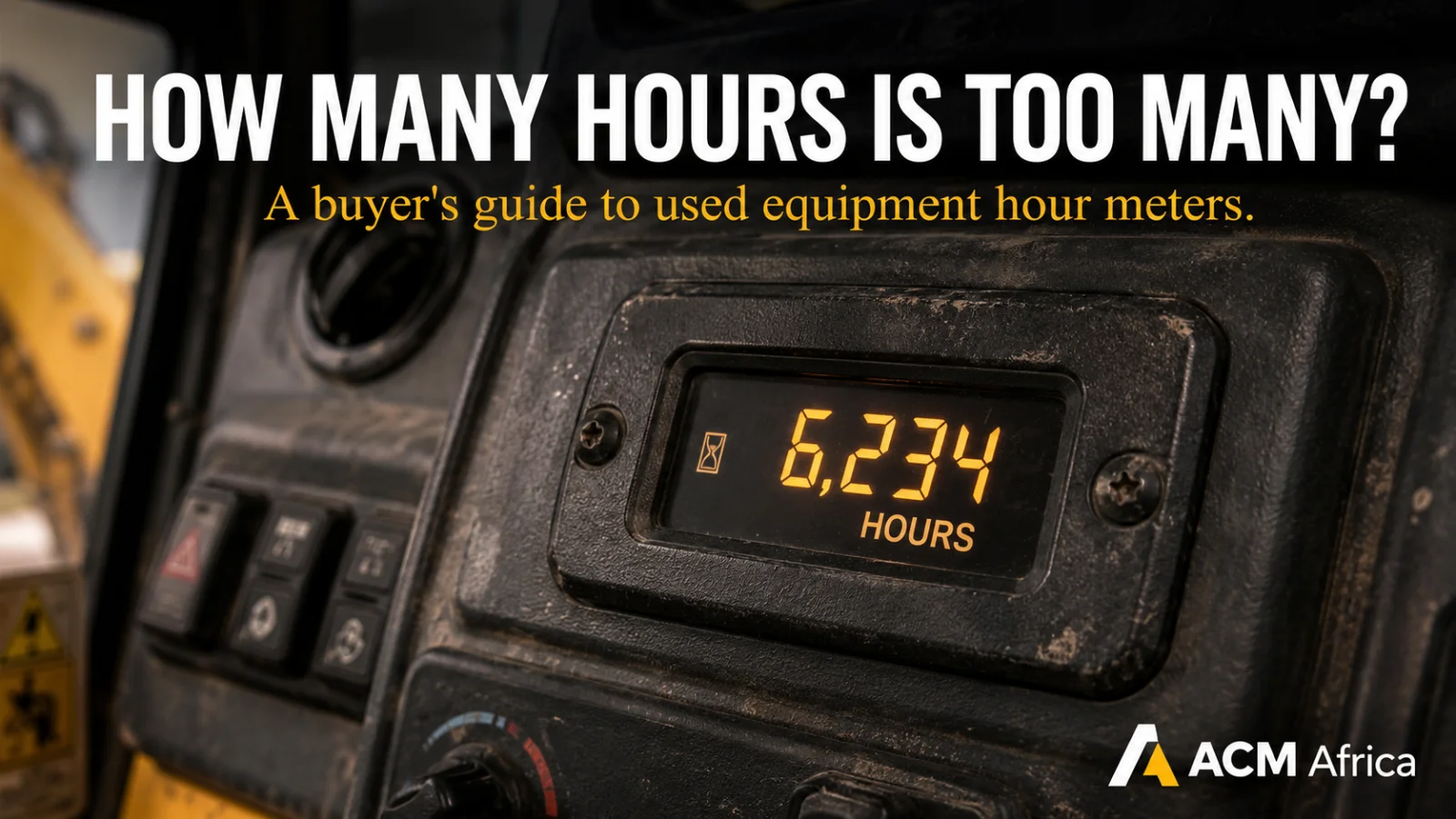
A used machine's hours are the first number buyers look at and the most misinterpreted. A 6,000-hour TLB on a single farm doing seasonal field work is almost always a better buy than a 2,000-hour TLB that has done three years on a construction site. The number on the meter tells you a tiny fraction of the story. This guide tells you what's actually high and what's not for every major equipment category in South Africa — and the questions to ask before you pay.
We've watched hundreds of machines change hands on ACM Africa. The buyers who get the best deals all read the meter the same way: as one data point next to wear, service history, and the duty cycle the machine has lived under.

What Does the Hour Meter Actually Measure?
An hour meter ticks every minute the engine is running — not just when the machine is doing work. A forklift idling in a yard for an hour while the operator is on lunch adds 60 minutes to the meter without lifting a pallet.
Most modern machines have one of three meter types:
- Engine hours (the most common). Counts any time the key is on and the engine is running. The number you see on almost every TLB, tractor and wheel loader.
- Hydraulic / work hours. Found on most excavators above 10 tons. Counts only when the hydraulic system is loaded — i.e. the machine is actually working. Far more honest than engine hours.
- Key hours vs deadman hours (forklifts). Some forklifts log "key on" hours and "operator seated" hours separately. The seated/deadman number is the real one.
If you're buying an excavator or a TLB with both engine and hydraulic hours visible, the hydraulic number is what matters for wear assessment. Engine hours minus hydraulic hours roughly equals time spent idling — which is essentially wear without revenue.
Why Hours Alone Never Tell the Whole Story
Two machines, same hour reading, can be worlds apart. A wheel loader on a quarry running three shifts a day in fine dust will be more worn at 5,000 hours than the same model on a sand-quiet citrus farm at 9,000 hours.
The rough mental model we use:
(Hours × Duty Cycle) ÷ Maintenance Quality = Actual Wear
A 6,000-hour TLB that was serviced religiously every 250 hours, never ran above 70% load, and had one careful owner is almost always in better condition than a 2,000-hour TLB that skipped two services and got rented out to anyone with cash.
"Service history matters more than the meter reading. We've seen 12,000-hour wheel loaders outperform 6,000-hour wheel loaders because one was serviced on the dot and the other wasn't," is a pattern we see repeatedly in verified dealer activity on the platform.
How Many Hours Is Too Many? By Equipment Category
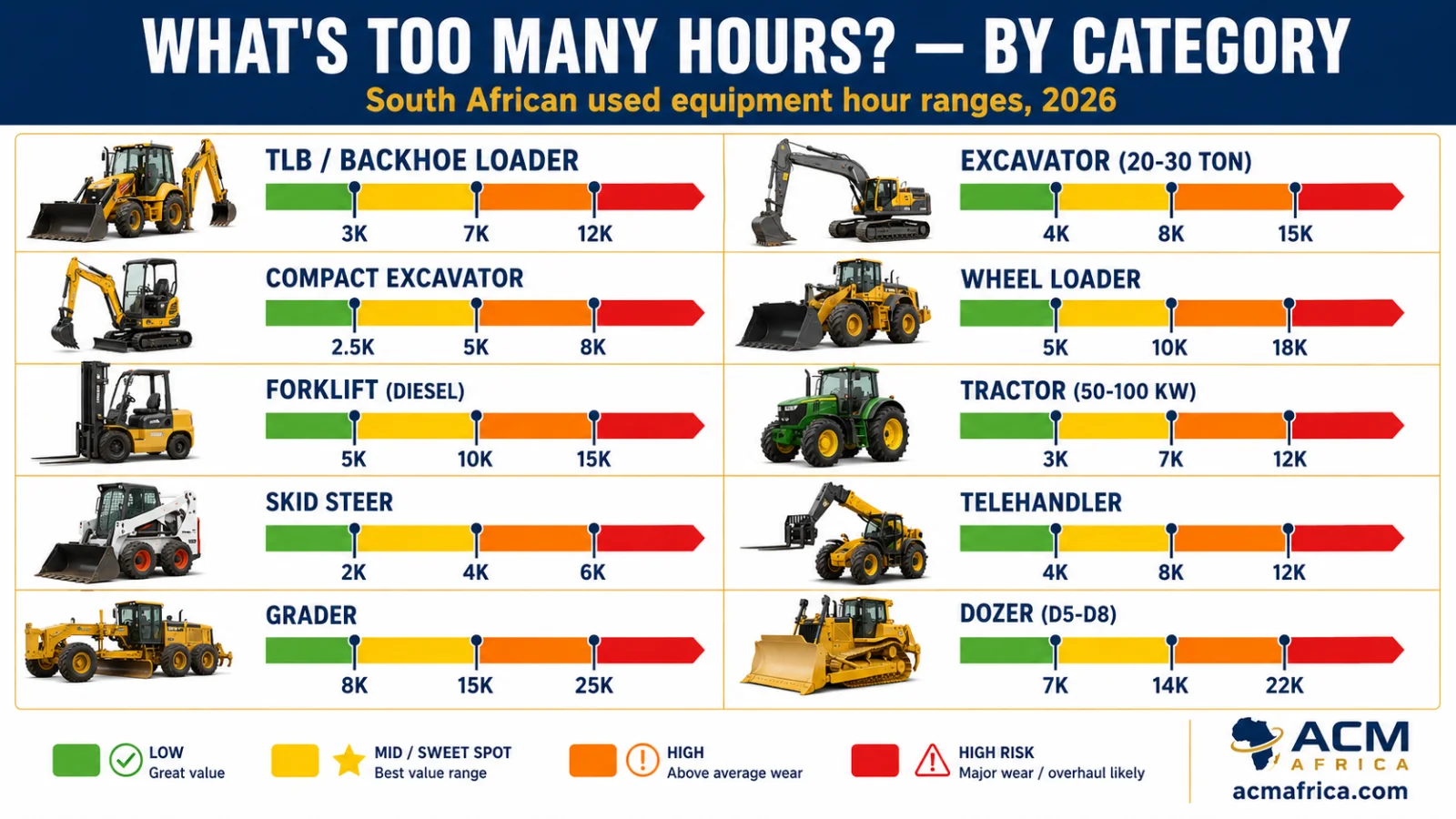
Below is the broad reference grid we use when assessing used equipment. These are working ranges for South African and SADC conditions — adjust downward for harsh duty (mining, coastal salt air, fine dust) and upward for light farm or yard duty.
| Category | Low hours | Mid (sweet spot) | High | High risk |
|---|---|---|---|---|
| TLB / Backhoe Loader | Under 3,000 | 3,000 – 7,000 | 7,000 – 12,000 | 12,000+ |
| Excavator (20–30 ton) | Under 4,000 | 4,000 – 8,000 | 8,000 – 15,000 | 15,000+ (rebuild due) |
| Compact Excavator (under 10 ton) | Under 2,500 | 2,500 – 5,000 | 5,000 – 8,000 | 8,000+ |
| Wheel Loader / Front-end Loader | Under 5,000 | 5,000 – 10,000 | 10,000 – 18,000 | 18,000+ |
| Forklift (diesel / LPG) | Under 5,000 | 5,000 – 10,000 | 10,000 – 15,000 | 15,000+ |
| Forklift (electric) | Battery condition matters more than hours — see section below. | |||
| Tractor (50–100 kW) | Under 3,000 | 3,000 – 7,000 | 7,000 – 12,000 | 12,000+ |
| Skid Steer | Under 2,000 | 2,000 – 4,000 | 4,000 – 6,000 | 6,000+ |
| Telehandler | Under 4,000 | 4,000 – 8,000 | 8,000 – 12,000 | 12,000+ |
| Grader | Under 8,000 | 8,000 – 15,000 | 15,000 – 25,000 | 25,000+ |
| Dozer (D5–D8 class) | Under 7,000 | 7,000 – 14,000 | 14,000 – 22,000 | 22,000+ |
| Articulated Dump Truck (ADT) | Under 10,000 | 10,000 – 20,000 | 20,000 – 30,000 | 30,000+ |
| Mining Haul Truck | Under 30,000 | 30,000 – 60,000 | 60,000 – 90,000 | 90,000+ |
A Note on Electric Forklifts
Electric forklift hours mean very little compared to battery condition. A 4,000-hour electric forklift with a brand-new R75,000 traction battery is in better shape than a 1,500-hour unit on a tired battery. Always ask: when was the battery last replaced, what is its measured capacity, and what's the warranty status.
What Service Milestones Should Every Buyer Know?
Almost every machine has major service points at the same hour marks. Knowing where in the cycle the machine sits is half the negotiation.
- 250 hours: Engine oil and filter, first service. Routine and cheap.
- 500 hours: Hydraulic and transmission fluid checks, filters.
- 1,000 hours: Major service — coolant, all filters, valve adjustments. R8,000 – R18,000 depending on machine.
- 2,000 hours: Larger fluid changes, injector check, drivetrain inspection.
- 5,000 hours: Mid-life rebuild zone. Hydraulic pump, turbo, water pump, alternator often replaced. R40,000 – R120,000.
- 10,000 hours: Full engine and hydraulic rebuild typically due. R150,000 – R400,000+ depending on machine size.
A machine just past its 5,000-hour rebuild is worth more than one approaching it. If a TLB shows 4,700 hours and the seller has no record of any rebuild work, you're 300 hours away from a potential R80,000 bill. Either negotiate that into the price or pass.
If a seller can produce invoices showing the 5,000-hour rebuild was completed, the same machine at 5,400 hours is effectively a "reset" — you're buying 5,000 fresh hours of life.
How Do You Spot a Wound-Back Hour Meter?
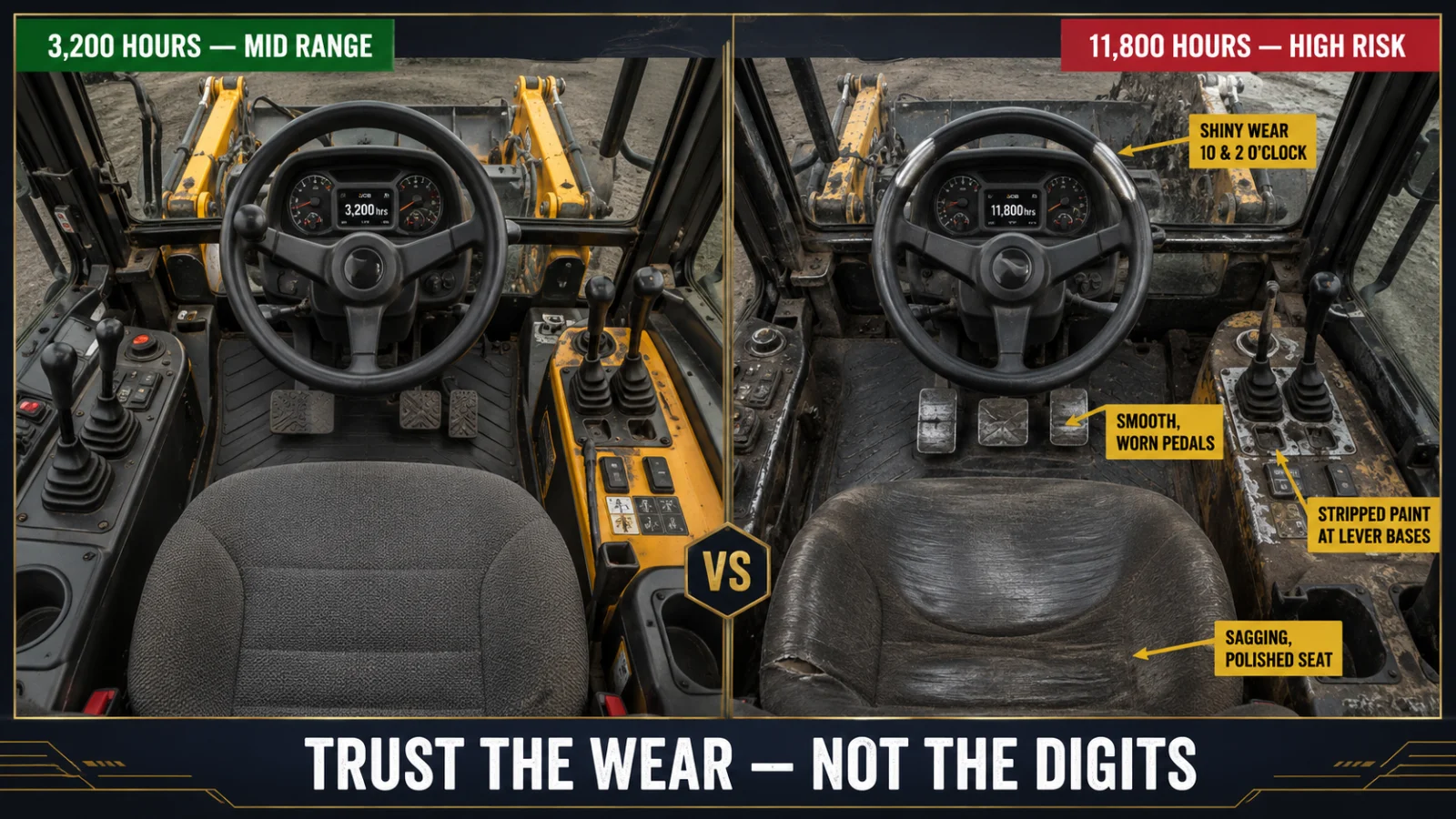
Trust the wear, not the digits. Hour meters can be wound back. Wear patterns can't.
Quick visual cross-check:
- Pedal rubbers and floor mat: A 4,000-hour machine should still have legible tread. Smooth, rounded pedals mean closer to 10,000 hours.
- Seat fabric and armrests: Compressed, sagging, polished armrests don't match a 3,000-hour claim.
- Steering wheel wear: Bright wear patches at 10 and 2 o'clock = high hours.
- Paint around lever bases: Bare metal around the loader and backhoe levers tells the truth the meter often won't.
- Undercarriage (excavators, dozers): Tracks, idlers and rollers wear linearly with hours. A worn undercarriage at "low hours" is a lie.
- Tyres (wheeled machines): Original-fitment tyres at heavy wear with low hours indicates either tampering or a single very bad operator.
If the wear says 12,000 hours and the meter says 4,000, the meter is lying. Our deeper-dive on TLB inspection covers this in detail — see 8 Things to Check Before Buying a Used TLB.
Engine Hours vs Hydraulic Hours: Which One Matters?
For excavators, TLBs and other hydraulic-heavy machines, hydraulic hours are the more honest reading. Engine hours tick while the operator eats lunch with the engine running. Hydraulic hours only tick when the machine is actually doing work.
The gap between the two tells you how the machine was used. Roughly:
- Idle ratio under 20%: Hard-working machine, every hour was productive. Often signals a contractor or quarry duty.
- Idle ratio 20–40%: Normal mixed-use. Most farm and general contracting machines fall here.
- Idle ratio over 40%: The engine was left running a lot. More carbon build-up, more glaze on cylinder walls, more diesel-dilution risk in the oil.
If a seller only quotes engine hours and won't tell you the hydraulic-hour reading, ask why. Modern machines from 2015 onwards almost always log both.
What About Machines With Too Few Hours?
Counterintuitive but important: a 7-year-old machine with only 800 hours is usually a worse buy than a 5-year-old machine with 4,000 hours.
Equipment is designed to be used. Under-used machines accumulate problems that working machines never get:
- Seals dry out and crack — every hydraulic ram needs replacing
- Diesel fuel goes stale; injectors gum up
- Coolant degrades and corrodes the engine internally
- Batteries die from sitting
- Tyres develop flat spots; rubber compounds harden
- Bearings rust where the lubricant has migrated away
A "barn find" 1,200-hour tractor that's been parked for five years often costs more to recommission than a 6,000-hour tractor that's been in continuous service. If a low-hour machine is much cheaper than market, ask very carefully why it has so few hours for its age.
When to Discount, When to Walk Away
Specific decision thresholds based on the categories above:
- TLB at 8,000 – 11,000 hours: Demand 15–25% off the mid-range used price. Ask for the next major-service invoice in writing.
- TLB at 12,000+ hours: Only buy with a complete rebuild record. Otherwise walk.
- 20-ton excavator at 13,000 – 15,000 hours: Demand a pre-purchase inspection by an independent technician. Budget R45,000+ for hydraulic-pump rebuild in the next 1,500 hours.
- 20-ton excavator at 15,000+ hours: Walk away unless the price reflects a near-full rebuild.
- Forklift at 12,000+ diesel hours: Inspect the mast and chain stretch — these are expensive to replace.
- Tractor at 10,000+ hours: Acceptable if the engine has been rebuilt and the documentation is solid.
- Grader at 20,000+ hours: Articulation pivots and circle wear plates need inspection.
What Should You Ask the Seller About Hours?
Use these six questions in your first WhatsApp or call with the seller. The answers will tell you whether the machine is worth a viewing:
- What's the meter reading right now? Get the actual number, not "about 6,000".
- When was the last full service, and at what hour mark?
- Has the engine ever been rebuilt? Hydraulic pump? Transmission? Ask for invoices.
- Does the machine show engine hours and hydraulic hours separately? What are both?
- What duty has the machine done — farm work, construction, mining, hire?
- Can I see the service book or the workshop's invoices? No paperwork = price down 10–20%.
"Sellers who answer those six questions confidently and in writing usually sell faster and at better prices. Sellers who get vague are telling you something," based on conversion patterns we see on ACM Africa.
The Bottom Line
Hours guide the negotiation. Hours don't make the decision.
A machine within the mid-range hours band for its category, with documented service history and visible wear that matches the meter, is worth its asking price. Anything outside that — too high, too low, or wear that doesn't match — needs either a discount or a deeper inspection.
When you're ready to look at active listings, browse used TLBs from MCM and other verified dealers, excavators, forklifts, or the full machines catalogue. Every listing on ACM Africa includes hours, condition status and seller contact via WhatsApp.