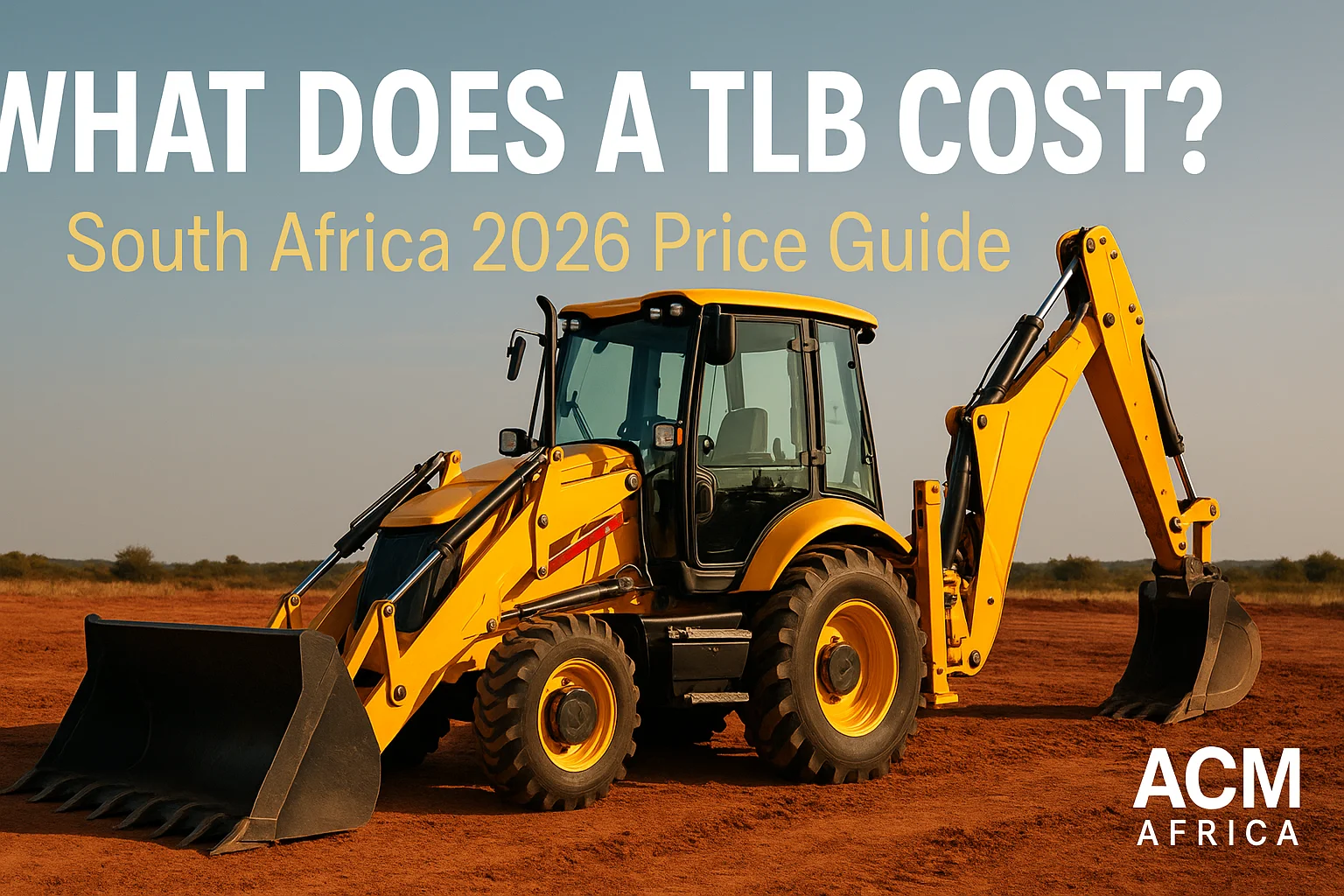
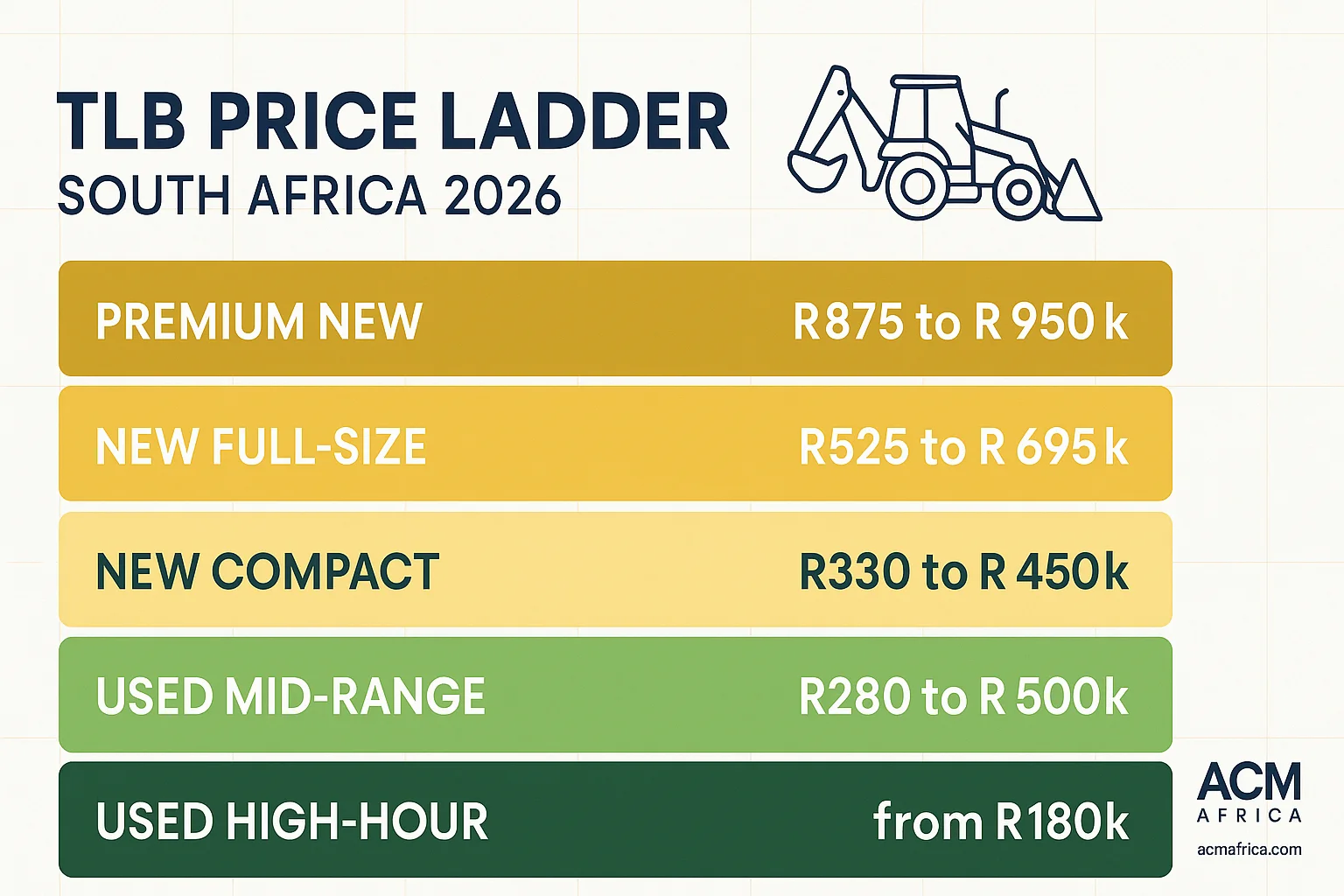
A new TLB in South Africa costs between roughly R329,500 and R950,000 in 2026, depending on brand and size, while used TLBs start at around R180,000. Those aren't estimates — they're current asking prices on live ACM Africa listings. This guide breaks down what new and used backhoe loaders actually cost right now, and explains exactly what drives the number on the price tag.
The TLB (tractor-loader-backhoe) is the workhorse of South African construction, farming, and municipal work. One machine digs, loads, lifts, and backfills. Because it does so much, pricing spans a huge range — and the market has shifted dramatically in the last five years.

How Much Does a TLB Cost in South Africa?
Here's the quick answer based on what's selling on ACM Africa right now:
| Category | Price range (2026) | What you get |
|---|---|---|
| Used, high-hour | R180,000 – R280,000 | Older established brand or high-hour value brand |
| Used, mid-range | R280,000 – R500,000 | Mid-hour CAT, JCB, Case, or near-new value brand |
| Used, low-hour / premium | R500,000 – R580,000 | Low-hour established brand, recent model |
| New, value brand (compact) | R329,500 – R450,000 | Entry to mid-size new machine with warranty |
| New, value brand (full-size) | R525,000 – R950,000 | Full-size new machine, latest spec, warranty |
The headline shift: you can now buy a brand-new TLB with a warranty for the same money a used import cost five years ago. Value brands have compressed the entire market.
What Do New TLBs Cost in South Africa?
New TLB pricing in 2026 is dominated by value brands — primarily Chinese-manufactured machines with growing local dealer and parts networks. Here are current new-machine asking prices on ACM Africa:
| Brand & Model | Price (new) | Positioning |
|---|---|---|
| MCM 18X | R329,500 | Entry / compact |
| MCM 27X | R399,500 | Compact |
| HZM 45-12S | R450,000 | Mid-size |
| MCM 37X | R525,000 | Mid-size |
| MCM 58X | R575,000 | Full-size |
| MCM 76X | R695,000 | Full-size, higher spec |
| LGMA LG388 | R875,000 | Full-size, premium value |
| ACE Phantom | R950,000 | Top of the new range |
A new machine buys you zero hours, a manufacturer warranty, the latest emissions and hydraulic spec, and — crucially — finance eligibility on the best terms. For a contractor billing daily, the warranty and uptime often justify the premium over a used unit.
What Do Used TLBs Cost in South Africa?
Used TLB pricing is driven by brand, hours, year, and condition. The same model can vary by R200,000 depending on how hard it has worked. Current used listings on ACM Africa:
| Machine | Hours / Year | Price (used) |
|---|---|---|
| MCM 37X | 2017, ~6,000 hrs | R180,000 |
| Bell 315 / 2008 Bell | High-hour | R270,000 |
| Case 580SM | 2003 | R379,900 |
| JCB 3CX | Used | R480,000 |
| MCM 58X | 132 hrs (nearly new) | R499,500 |
| CAT 428E | Low-hour | R579,900 |
Notice the MCM 58X with just 132 hours at R499,500 — that's a near-new machine at a meaningful discount off the R575,000 new price, because the moment a machine leaves the dealer it carries "used" status. Hours and condition matter more than the badge on a used TLB. Before paying, read our guide on how many hours is too many on used equipment and the full 8-point TLB inspection checklist.
Why Are Chinese-Brand TLBs So Much Cheaper Than CAT or JCB?
Value-brand TLBs typically sell 25–40% below European or Japanese equivalents when new. There are real reasons for the gap — and real questions to ask before you buy.
Why they cost less:
- Lower manufacturing cost. Chinese factories produce at scale with lower labour and overhead costs.
- Simpler, proven componentry. Many use well-known engine and hydraulic platforms rather than proprietary systems.
- Leaner distribution. Brands like MCM, HZM, LGMA and ACE sell with shorter supply chains and less dealer mark-up.
The real questions to ask aren't about the sticker price — they're about ownership:
- Is there a local dealer who stocks parts? (MCM, HZM, LGMA and ACE all have a growing SA presence.)
- What's the warranty, and who honours it?
- How available are filters, seals, and wear parts?
"The sticker price is the easy part. The question that actually decides value is whether you can get a hydraulic seal kit or a starter motor in 48 hours when the machine is down," is the lens we'd apply when comparing a value brand to a premium one.
New vs Used TLB: Which Is the Better Buy?
It depends on how hard you'll work the machine and how you're paying for it.
Buy new if:
- You're financing — new machines get the best rates and longest terms
- The TLB will work daily and downtime costs you money (warranty matters)
- You want a known history — zero hours, no inherited wear
Buy used if:
- You need the lowest entry price and have cash
- Usage will be occasional (farm, smallholding, light municipal work)
- You can inspect properly or bring someone who can
The break-even logic: a new value-brand machine at R450,000 with a warranty often beats a R380,000 twenty-year-old import once you price in the repair risk and resale. But a well-kept used CAT or JCB holds value better than almost anything else on the market.
What Affects a TLB's Price?
Two TLBs of the same model can differ by hundreds of thousands of rand. The factors that move the price:
- Brand: Established brands (CAT, JCB, Case, Bell) hold value; value brands cost less new and used.
- Hours: The single biggest used-price driver. A 6,000-hour machine is worth far less than a 1,000-hour one.
- Year and model: Newer emissions and hydraulic specs command more.
- Condition and service history: Full service records can add 10–20% to a used machine's value.
- 2WD vs 4WD: 4WD machines cost more and are worth it for wet or uneven sites.
- Attachments: Side-shift, extra buckets, and hammer/breaker hydraulic plumbing add real value.
- Location and transport: A machine three provinces away costs more once you factor in lowbed transport.
What's the Cheapest Way to Get Into a TLB?
The cheapest honest entry point is a well-maintained used machine in the R180,000–R280,000 band — either a high-hour value brand like the 2017 MCM 37X at R180,000, or an older established brand like the Bell 315 at R270,000.
But beware the false economy. The cheapest high-hour machine is only a bargain if it's mechanically sound. A R180,000 TLB that needs a R90,000 hydraulic rebuild three months in costs more than a R260,000 machine that's ready to work. Always inspect — our 8-point TLB inspection guide walks through exactly what to check before you pay.
How Does TLB Financing Work in South Africa?
Most asset finance houses and the major banks finance TLBs, both new and used, typically up to 5–7 years old. The general shape of a deal:
- Deposit: usually 10–20% upfront
- Term: typically 36–60 months
- Fastest route: dealer-arranged finance — dealers like MCM often have existing relationships with asset financiers
New machines get the best rates because the financier has clean collateral with a known value. Older used machines are harder to finance and usually carry higher interest. ACM Africa does not provide finance directly — arrange it through your bank, an asset finance house, or the dealer.
Where Can You Buy a TLB in South Africa?
ACM Africa lists new and used TLBs from verified dealers — including MCM, HZM, LGMA and ACE — alongside private sellers, all with direct WhatsApp contact. You can browse all TLB listings and filter by price, hours, brand, and province to compare what's actually available right now.
Because every listing shows the asking price, hours, and condition up front, you can benchmark any machine against the current market in minutes — exactly the data this guide is built on. Browse verified equipment dealers or the full machines catalogue to start comparing.
The Bottom Line on TLB Prices
The South African TLB market has been reshaped by value brands. A brand-new machine with a warranty now starts at R329,500 — territory that used to mean a tired second-hand import. Used machines still offer the lowest entry price, from R180,000, but you inherit the previous owner's wear.
Match the machine to the work, inspect any used unit properly, and always compare against current listings before you commit. The right TLB is the one that fits your budget, your duty cycle, and your finance situation — not just the cheapest number you can find.
Ready to buy a TLB?
Browse new and used TLBs for sale in South Africa on ACM Africa — from MCM, HZM, ACE, CASE, JCB and more. Compare prices and contact sellers directly on WhatsApp, no middleman.
Browse TLBs for sale →